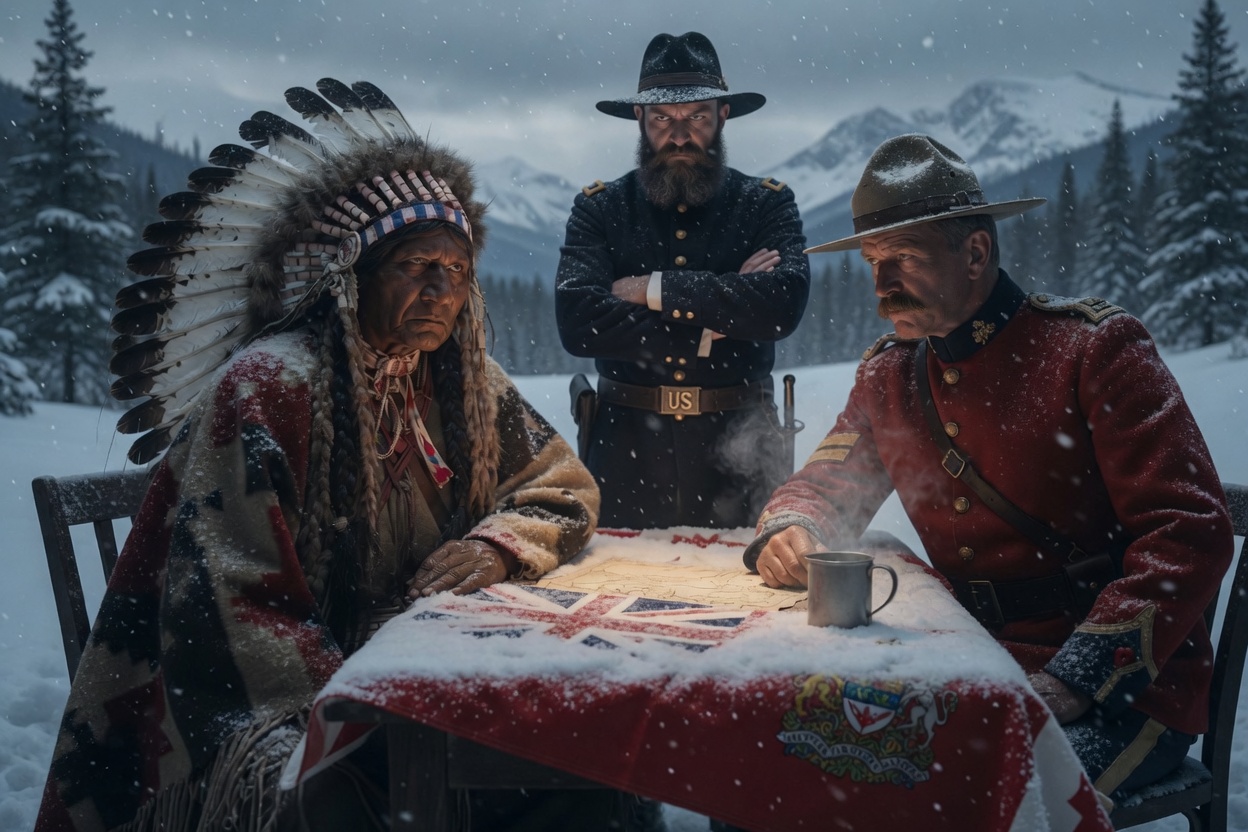
The Uniform
and the Man
A history of the Royal Canadian Mounted Police uniform — how three hundred men in scarlet became a substitute for a garrison, and what happened when the cloth outlived the conditions that earned it.
There was a time when the uniform of the Royal Canadian Mounted Police announced itself before a word was spoken. Scarlet tunic cut close to the torso, breeches of midnight blue with a single yellow stripe running razor-sharp down the seam, Stetson tilted just so, boots polished until they reflected the sky: the ensemble was not mere costume but declaration.
It belonged to men who sat tall in the saddle because they had earned the right to be seen from a distance. One glance and the message was unmistakable: here was authority that had been measured, fitted, and pressed into service.
That uniform did not emerge from committee or focus group. It was forged in the nineteenth century for a constabulary expected to ride hundreds of miles across prairie and mountain, impose order where none existed, and do so without the luxury of backup. The scarlet was chosen to distinguish it from the blue of the American cavalry; the tailoring assumed a certain physique and a certain discipline. The man inside it was not incidental. He was the point.
To grasp what has been lost, one must return to the mind of Sir John A. Macdonald, who summoned the force into existence in 1873 and who entertained no illusions about what it was for. Macdonald was not a sentimentalist. He had watched the American expansion westward, and he had seen what it cost: blue-coated cavalry regiments stationed in expensive garrisons, ruinous expeditions of conquest, the brutal arithmetic of the Indian Wars conducted by a standing army that the Dominion of Canada could neither afford nor philosophically tolerate.
He wanted something else. He wanted a force that could do the same work — extend the writ of the Crown across a continent — without the cost of military occupation and without its theatre.
The result was something almost without precedent in the Anglo-American tradition: a hybrid creature, neither army nor civilian police, designed to operate on the seam between the two. Mounted riflemen, the early drafts called them. They were to ride and they were to shoot, but they were also to arrest, to mediate, to act as magistrates in regions where no court would sit for another twenty years.
Macdonald's governing instruction was characteristically frugal and characteristically shrewd: a force “of a civil character,” with “all appearance of a military body” deliberately suppressed. He did not want a regiment. He wanted a constabulary that could fight if it had to, ride forever if necessary, and project the Crown's authority through nothing more elaborate than the visible competence of the men carrying it.
His reference was the Royal Irish Constabulary — barracked, armed, drilled, uniformed, yet constitutionally civil. Macdonald lifted the structural insight and discarded what would not travel. The Irish model assumed a country small enough to be saturated with barracks. The Canadian application would have to do the opposite.
What the RIC achieved through density of presence, the NWMP would achieve through the symbolic weight carried by very few men over very great distances.
The Arithmetic of a Cheap Empire
Macdonald's Dominion in 1873 was a coalition of provinces held together by debt, railway promises, and his own political genius. There was no money. The North-West Mounted Police was, among other things, a fiscal device.
The Crown's entire authority across a territory larger than continental Europe. A force that small could not garrison anything. It had to ride, present itself, and depart.
Walsh rode in with twelve men. Sitting Bull had perhaps four thousand people with him, several hundred of them warriors who had recently annihilated Custer's command.
Washington complained the Mounties were too lenient with the fugitives; the Lakota complained they were too strict about the rules. Both complaints were evidence the policy worked.
The colour Indigenous nations of the plains already associated with an authority that kept its word more often than not. Utilitarian. Diplomatic. Cheap legitimacy.
The colour of the columns that had butchered their way through Sand Creek and the Washita. A Mountie cresting a ridge in scarlet was instantly not that.
The decision to forgo blue was not aesthetic. It was operational — a peace offering issued with a Snider carbine across the saddle, but a peace offering nonetheless.
A Century and a Half of Serge
Fig. 4 — Chronology{{ ev.body }}
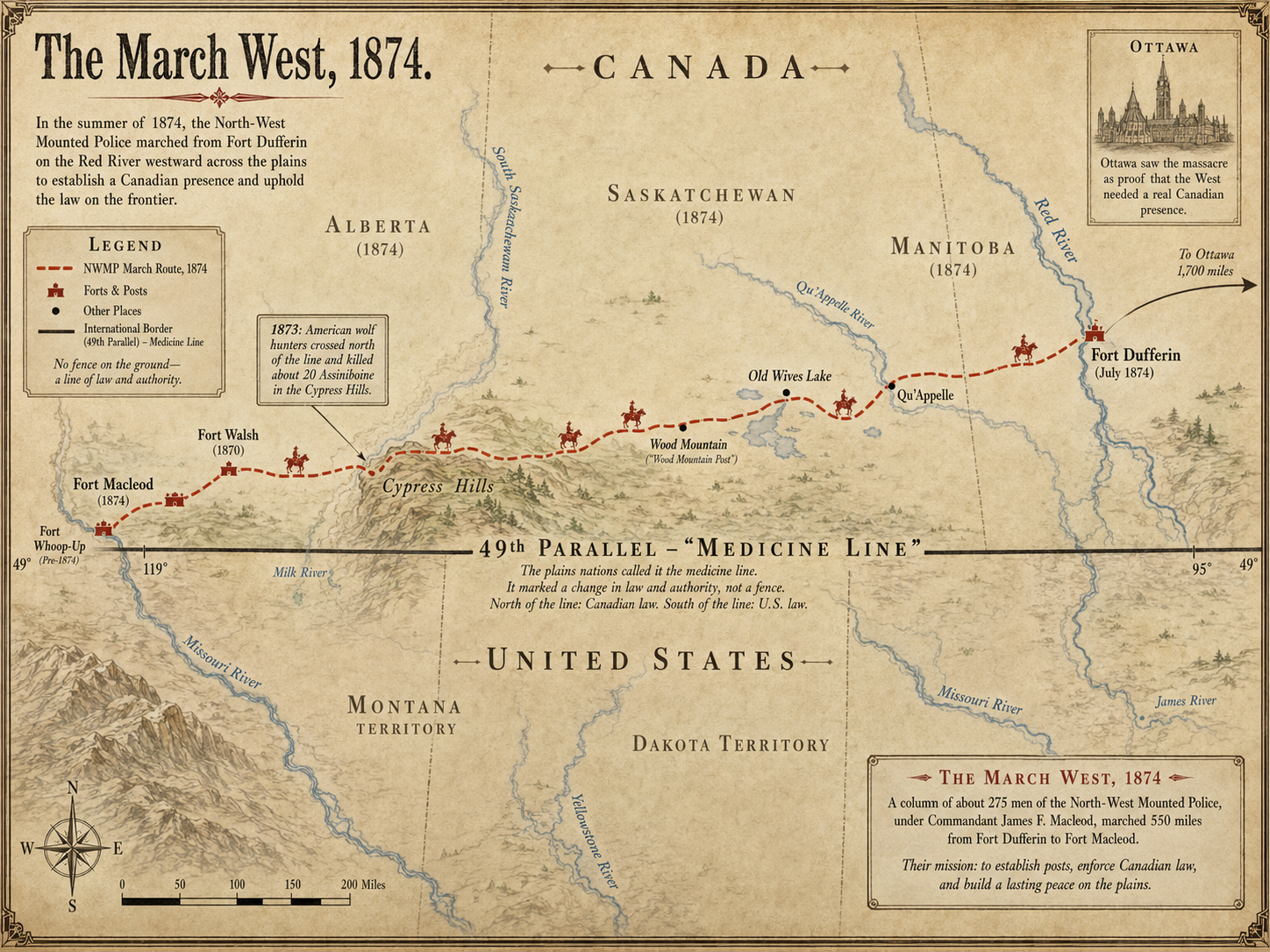
The Cypress Hills Massacre concentrated the matter. The North-West Mounted Police was Macdonald's answer, drafted into legislation within months, and the men who set out on the Great March West the following summer carried a mandate that was less about uniforms than about velocity, range, and credible threat. The uniform would be sorted out. The riding had to begin at once.
There were three hundred of them. Three hundred men were to be the Crown's authority across an area larger than continental Europe. Macdonald understood the absurdity of the ratio and counted on it as a feature rather than a bug. A force that small could not garrison anything. It had to ride, present itself, and depart, leaving behind the impression that more would follow if needed.
The uniform was the multiplier. A single Mountie cresting a ridge in scarlet had to do the work of a company of infantry, and he did so because Sitting Bull, when he crossed the medicine line after the Little Bighorn, found James Walsh waiting for him with a handful of men in red coats and was assured, correctly, that the Crown's word would be honoured here in a way it had not been honoured south of the line.
That was the bargain. The uniform meant something because the men inside it had committed themselves to making it mean something, and Macdonald had committed the Dominion to backing them with whatever scarce capital it possessed.
Twelve Men in a Lodge
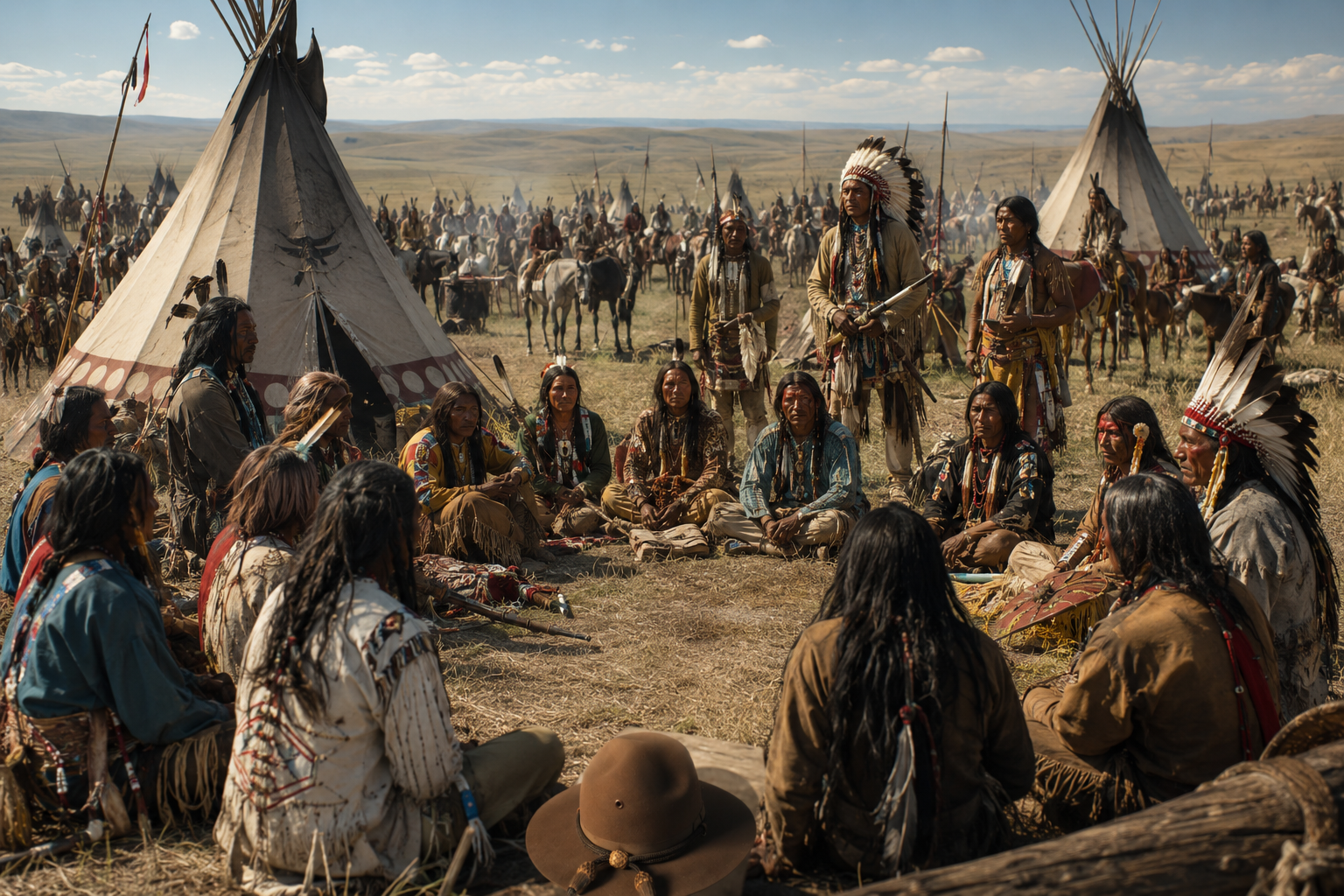
The Walsh encounter is the entire theory of the force compressed into a single meeting. Walsh dismounted, walked into the lodge, sat down, and explained the rules. There would be no raiding back across the line. There would be no horse theft. There would be no whisky. In return, the Lakota would be protected from the American cavalry that had been hunting them, and would be treated as guests of the Crown for as long as they remained on Canadian soil.
Sitting Bull, who had been deceived by uniforms his entire adult life, looked at the man in front of him and decided, against the run of his own experience, to believe him. He believed him because Walsh was visibly serious — pressed, armed, mounted, alone — and because the colour of his coat was attached to a name that, on the northern plains at least, had not yet been used to lie.
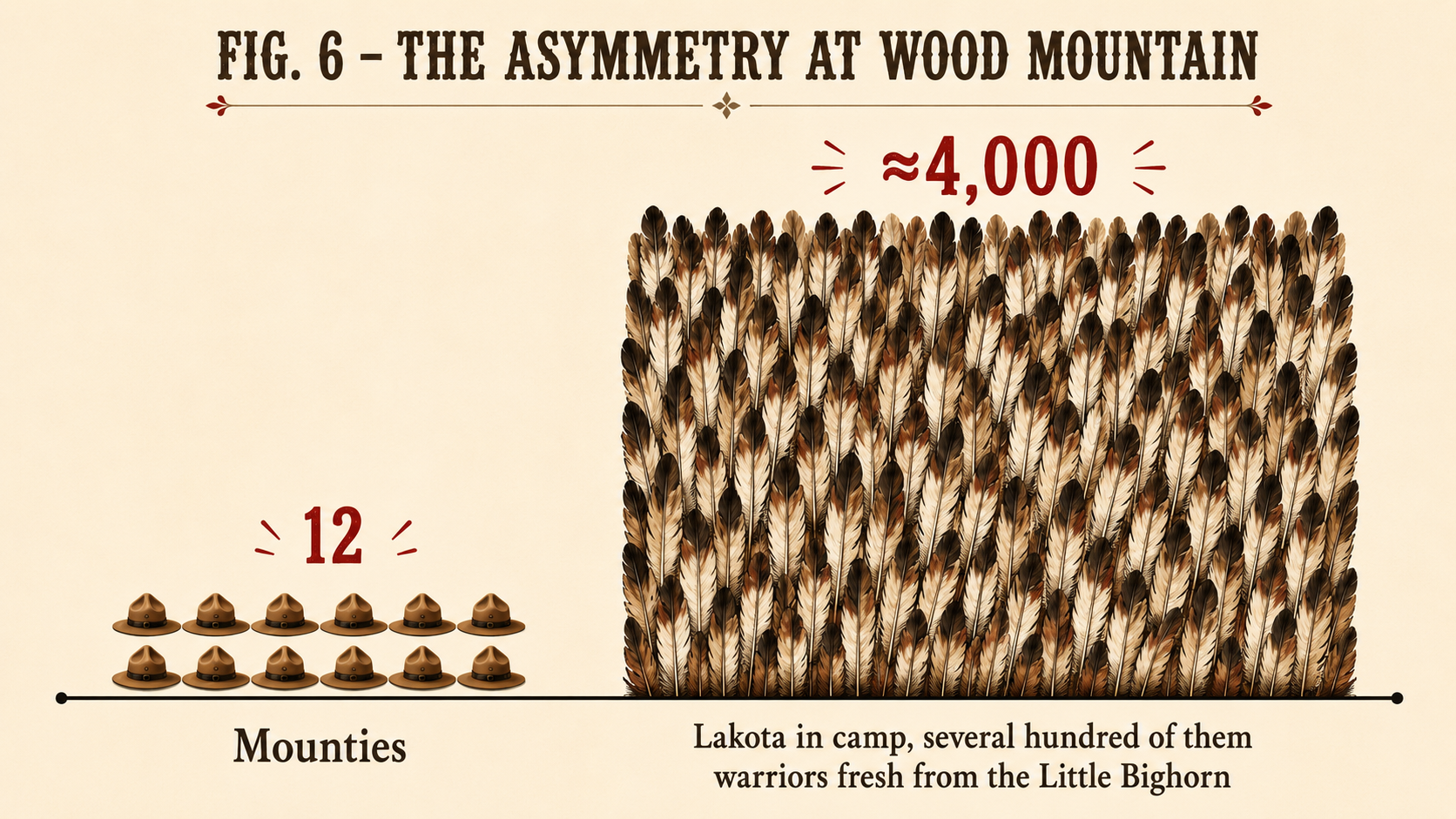
The uniform had bought what no quantity of cavalry could have bought — the willing compliance of a nation that outnumbered the Crown's representatives on the spot by a hundred to one. That is what the scarlet tunic was for. Anyone who supposes it was for the photograph at graduation has misread the entire archive.
What is striking, on a careful reading of the early force's regulations, is how little of it concerned spectacle. The drill manuals are spare. The grooming requirements are practical: clean-shaven or a moustache cut close, hair short enough to fit beneath the pillbox cap and later the Stetson, boots polished not for ceremony but because cracked leather rotted in the prairie wet.
Sam Steele, who would become the force's most celebrated officer, was famous less for sartorial precision than for his willingness to march men into the ground and shoot anyone who needed shooting. The discipline that produced the iconic image was not the discipline of the parade square. It was the discipline of men who knew that on any given day they might find themselves alone in a saloon facing a dozen armed whisky traders with nothing but a sidearm and the certainty that the Crown would, eventually, send word of what had happened.
Out of that operational reality, almost as a side effect, the uniform became sacred. Not because anyone had set out to make it sacred — because the men who wore it had earned every thread. The scarlet tunic of 1885 did not look the way it did because some quartermaster had insisted upon creases. It looked that way because Steele's troopers, who had ridden five hundred miles to put down the North-West Rebellion, would have considered a slovenly turnout an insult to themselves and to the institution they had built with their own backs.
Macdonald's instruction to avoid military display did not produce a slack force. It produced a force in which display was earned, organic, and therefore far more potent than any imposed ceremonial. The paradox at the heart of the institution was that by refusing to insist on pomp, it summoned more of it. The men supplied what the regulations did not require.
This is the inheritance the modern Royal Canadian Mounted Police has spent the better part of forty years dismantling, mostly without noticing that it was doing so. Look at the force today and the contrast is pitiless. Recruit photographs and public appearances now routinely display service shirts that appear to have been stored in a duffel bag, trousers that bag at the knee, and postures that suggest the wearer has already conceded the argument. The red serge is still issued for ceremonial occasions, yet even then the creases are softer, the shoulders less square, the overall impression less of command than of compliance.
The decline is not the result of a single policy. It is the cumulative product of a hundred small decisions, each of which seemed reasonable at the time. The institution discovered, as institutions tend to, that it was easier to lower the gate than to widen the path through it. Each individual concession seemed humane. Their accumulation has produced a force visibly less formidable than the one that existed when Macdonald drafted its charter — and visibly less formidable, in fact, than the one that existed thirty years ago.
There is a longer arc behind the immediate decay. The original operational logic — small detachments, vast distances, the uniform as substitute for numbers — survived into the postwar period, when Mounties still patrolled on horseback in some districts and served as the sole representative of federal authority across the North. That world ended quietly between roughly 1970 and 1990, as the force completed its transition into a modern federal police service: car-mounted, urbanized, absorbed into provincial contract policing. The scarlet tunic survived the transition. The conditions that had earned it did not.
This is not a complaint about demographics. Short officers, women, officers whose ancestors arrived more recently: none of these facts are disqualifying in themselves. A five-foot-eight constable who presses her tunic until the fabric could cut paper, and who maintains the physical condition demanded by the job, will still look the part. The insult lies elsewhere — in the quiet, relentless lowering of the bar so that appearance and effort no longer matter as much as representation.
When the institution ceases to insist on spit-and-polish standards, when fitness tests are adjusted and uniform discipline is treated as optional, the result is not inclusion. It is dilution. The public sees it at once. So does the uniform itself, which was never designed to flatter mediocrity.
There is no contradiction between admitting any candidate who can meet the standard and refusing to admit any candidate who cannot. Macdonald's force never imagined itself as a vehicle of demographic justice; it also never imagined itself as a vehicle of demographic exclusion. It imagined itself, exclusively, as a vehicle for the projection of credible authority across a vast and lightly governed territory. The modern force has reversed the order of operations. It has decided who is welcome first and adjusted what the work requires afterward.
Canada, a country already afflicted by a certain genteel reluctance to assert itself, has allowed one of its most potent symbols to sag into something apologetic. The Mountie was never meant to be cuddly or relatable; he was meant to be formidable. The loss is not sentimental. It is practical. Authority that looks provisional will be tested more often and respected less.
Fashion, that supposedly frivolous register of cultural self-regard, records the same decline: a once-uncompromising silhouette reduced to the visual equivalent of a shrug.
Institutional Dress, Institutional Muscle
The slow disarmament of the visual register is of a piece with a broader habit of treating institutions as costume rather than substance. In each case the dress is preserved while the muscle beneath it atrophies.
{{ inst.body }}
The Mountie in his rumpled shirt is merely the most photogenic example of a national tendency. He looks the way the country has chosen to feel: present, polite, no longer entirely sure what he is for.
It is not really about boots and creases. It is about whether a country that no longer demands much of itself can credibly demand anything of anyone else. A constable who does not iron his shirt is making a small statement about the seriousness with which he takes his uniform; an institution that no longer requires the shirt to be ironed is making a much larger statement about the seriousness with which it takes itself. The signal travels. Citizens read it accurately. Adversaries read it more accurately still.
The whisky traders of 1874 had no doubt what the scarlet tunic represented when it appeared in their camp, because the men inside the tunic had left them no room for doubt. It is genuinely unclear what the equivalent signal communicates today, and the unclarity is itself the diagnosis.
The remedy is as obvious as it is unfashionable. Restore the standards the uniform was built to enforce. Demand that every officer who wears it — regardless of height, sex, or ancestry — meets the physical and sartorial criteria that once made the image iconic. The scarlet tunic will do the rest. It always did.
He believed that if you found three hundred of the right people and gave them the right tools and the right colour to wear, they would extend the Crown's authority across a continent. He did not believe the uniform would produce the man. He believed the man would produce the uniform, and that the uniform, in turn, would amplify the man across a distance no individual could otherwise project.
That if you put enough people in the uniform, the uniform will do the work of producing the qualities the institution is no longer willing to demand. This is, in the strictest sense, a magical theory of tailoring. It has no precedent in the history of the force, or of any serious institution. It is being tested in real time, in front of a public that has begun to register the result.
The country, sooner or later,
will have to decide
whether it knows it too.